
Dancers
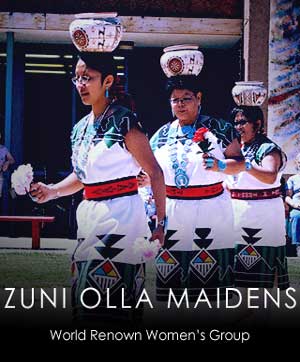
Zuni Olla Maidens
The Zuni Olla Maidens are a group of women who travel throughout the U.S. and Canada promoting the beauty and culture of the women of Zuni. They have been showcased at the 1995 Festival of American Folk Life in Washington, D.C., The Museum of Women in the Arts (also in Washington), The Banff Centre for the Arts in Banff, Canada and the Ganandogan Native American Music Festival in Rochester, New York.
They have performed for many years at the Inter-Tribal Indian Ceremonial in Gallup, New Mexico. They have also been featured in calendars and magazines.They have been featured in a documentary along with these women performing artists: Rita Coolidge and Walela, Ulali and the Tuscarora Women Singers. The documentary is called, “Singing Their Songs.” It is featured a many colleges as part of their Native American studies.
The Olla Maidens also perform at many functions which promote indigenous people as performing artists. They are very active in community events and participate in cultural fairs and festivals. They are acknowledged for their skill in dancing to the beat of a drum while balancing painted pottery jars on their head. They sing songs in their Native language (Zuni) while accompanying themselves with a drum, rattle and a wooden notched box which emits the sound of a chorus of frogs when stroked with a wooden stick.
This group under the direction of their leader, Cornelia Bowannie, is unique in that they are all related through blood ties. Cornelia, the matriarch, has daughters, an aunt and granddaughters who participate in the dance group. The group has been performing together for many years.
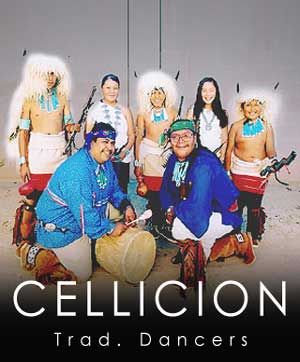
Cellicion
Fernando Cellicion is an internationally renowned Native flute player, singer, performer and recording artist. He is a member of the Zuni Tribe and lives in the Pueblo of Zuni in the state of New Mexico. He is also the director of the The Cellicion Traditional Zuni Dancers. Both Fernando and his dance troupe have traveled and performed throughout the United States, Canada, Parts of Europe, Asia, Southeast Asia and the South Pacific.
The dance troupe has passed on the family tradition in the performing arts to their own children. This third generation of performers are known as the The Cellicion Traditional Junior Dancers.
These children are all under the age of ten and have learned the songs and dances at a very early age. As a special highlight, the young ones will join the adult dancers to create a bigger group and give the audiences a better look at the dances done by dancers of all ages. Some of the dances performed are the Eagle Dance, the Pottery Dance, The Zuni Turkey Dance, The Deer Dance, The Star Dance, The White Buffalo Dance, The Rainbow Dance, The Harvest Dance and The Cloud Dance.
Fernando and his group believe in sharing and educating one another to learn a little bit about social cultures. Hopefully this will help the people understand one another better to bring peace, harmony and unity among the people throughout Mother Earth.
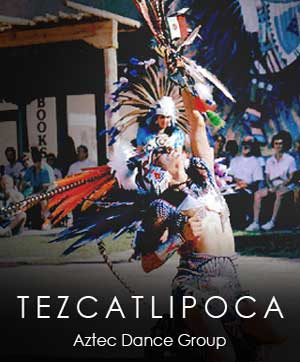
Tezcatlipoca
The Tezcatlipoca Aztec Dancers from Mexico City are led by Apolinar Simbron. The Aztec Indians inhabited the plains of Mexico from the 11th century to the beginning of the 16th century. The Aztecs spoke a language called Nahuatl, which is still used by over a million Mexicans today, although Spanish is their official language.In 1324, the Aztecs settled in an island village called Tenochtitlan, which later grew into a large town. Mexico City is built on the same spot.
In 1519, Hernando Cortez, a Spanish explorer landed in Mexico, marched to Tenochtitlan and took the Aztec King Montezuma prisoner. Two years later, he finally defeated the Aztecs and destroyed their city.
Over the years, the Aztecs had constructed many beautiful palaces and pyramid-shaped temples for the worship of their numerous gods. Fortunately, not everything belonging to the Aztec civilization has disappeared. There are many well preserved architectural remains-sacrificial platforms, temples and a remarkable calendar stone. Bless the ground and the four cardinal points and ask permission from our ancestors and our Great Spirit to be able to do our dances. Dance of the Shipitotec. This particular dance dedicated to the spring season when Mother Earth changes and begins a new life so the Aztecs can start a new cycle of planting their corn and fruits.
Guadalajara – This dance is dedicated to one of the cities in Mexico. Guadalajara is located in the state of Jalisco on the Pacific Coast.
Dance of Itzacuautll or Dance of the White Eagle – According to Aztec mythology, when a warrior dies in combat, the eagle descends and takes the fallen warriors’ spirit uyp to our creator.
La Danza Del Sol or Sun Dance – The Sun dance is dedicated to our sun, without our Father Sun there would not be any life on our planet.
Tonanzin or Mother Earth – This dance is dedicated to Tonanzin or our Mother Earth. We celebrate this dance every year in Mexico City on December 12th.
Dance of the Chachayoti – This dance is dedicated to the seeds that are worn on the ankles. These seeds help the Aztecs keep the rhythm of the drum.
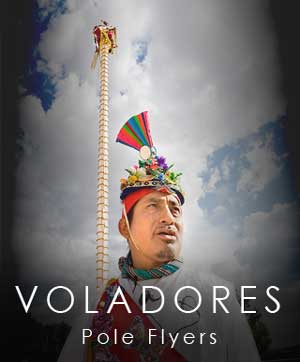
Voladores
The Voladores from Papantla, Vera Cruz, Mexico represent 57 tribes in Mexico. This sacred ceremony is dedicated to the sun and is similar in intent to the sun dance of the Plains Indians of the United States.
The Totonac dress for this ritual consists of a red pants with a white shirt, a cloth across the chest and a cap. The pants, hat and chest cloth are heavily embroidered and otherwise decorated. The cloth across the chest symbolized blood. The hat is adorned with flowers for fertility, mirrors represent the sun and from the top stream multi-colored ribbons representing the rainbow. These costumes are made by the Voladores themselves.
The pole is a connection point between the sky and the earth and the underworld with the surface world, and it is considered to be the fifth cardinal direction of the earth. The pole and the dancers are then purified with alcohol sprinkled in the form of a cross and tobacco smoke. The ceremony begins with a dance and song. After this, the five begin to climb the pole until near the end of the ceremony. The captain stands on a small platform at the top of the pole. From this capstan is suspended a square frame on which the other four Voladores sit.
While these four wind the ropes around the pole and tie themselves to the ends, the captain plays the flute and drum acknowledging the four cardinal directions, beginning with the east because it is believed life came from this direction. The four ropes are each wound thirteen times, which times four is fifty two, the number of years in a Mesoamerican solar cycle. The captain then bends fully backwards to acknowledge the sun, playing all the while.
The four Voladores represent the four cardinal directions as well as the four elements: earth, air, fire and water. The captain represents the fifth sun. The four Voladores seated on the square frame face the captain and at the appropriate moment fall backwards to descend to the ground suspended by the wound ropes. As the ropes unwind, the Voladores spin, creating a moving pyramid shape. As the Voladores descend the captain plays and dances on the narrow platform. Traditionally, after the descent, there is another dance.
Allenroy Paquin
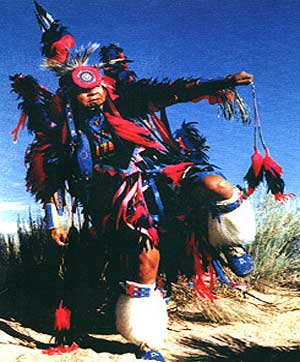
Allenroy Paquin is of the Jicarilla Apache and Zuni Tribes of New Mexico. He was raised in Albuquerque and learned beadwork and Plains Indian dance at a very early age. He is an accomplished silversmith. His father, a Zuni tribal member, taught him the art of Zuni jewelry making. He is also a flute player and has an album titled, “Just Playin’ Fancy.”
Allenroy believes that art and dance are important to preserve his culture. His performance is exciting, educational and informative. He educates students and the general public on the history and differences of the Indian tries so he can abolish racial barriers and break down the stereotypes of Hollywood Indians. He sets an example for Native youth by living a drug and alcohol free lifestyle. His program includes; Northern and Southern Fancy dance, Pipe Dance, Lance and Shield Dance, Round Dance, Flute playing and Story Telling.
He was a performer with Tribal Jam in the 2002 Winter Olympics in Salt Lake City, Utah. Allenroy is a champion Fancy Dancer and competes in Powwows across the United States.
READY TO BOOK?

Native Stars Studios - New Mexico's Full Production Company in the West's Native Country.
CONTACT
204 W. Coal Ave.
Gallup, NM
P: 505-619-8653
E: knifewing@nativestars.com
© COPYRIGHT 2026. GALLUP, NEW MEXICO. ALL RIGHTS RESERVED. REPRODUCTION OF CONTENT WITHOUT PERMISSION IS PROHIBITED.